


The Future of Dentistry: 3D Printing, Digital Scans & AI | Marcos White
How is digital technology changing modern dentistry, and what does it actually mean for patients?
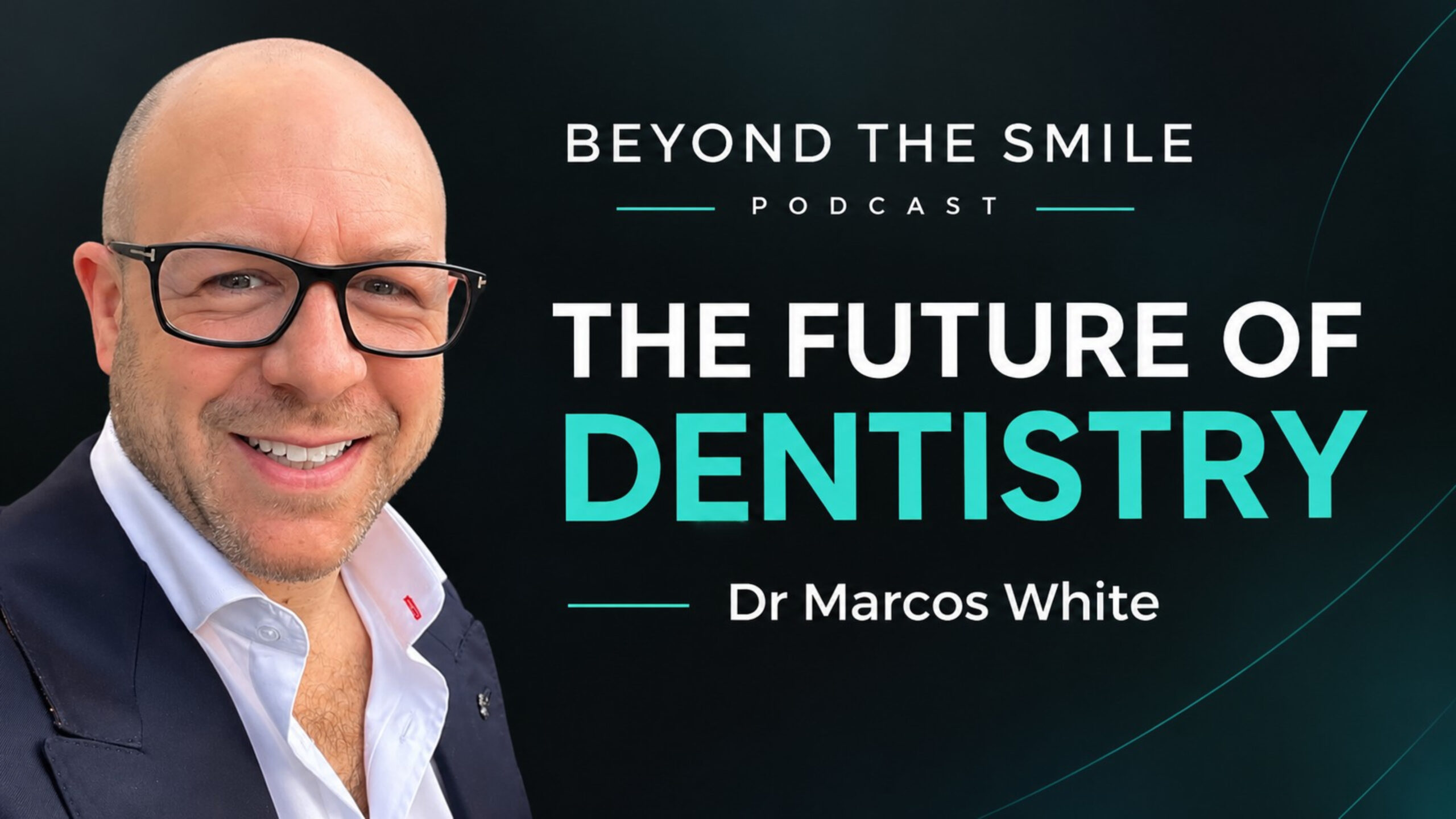
In this episode of the Beyond the Smile Podcast, Ed O’Flaherty talks to Dr Marcos White of The Courtyard Dental Clinic in Yorkshire, founder of Velvet Laboratory.
They talk about intraoral scanners, 3D-printed crowns, fully digital implant workflows and the future of AI in dental care. Marcos also shares his journey from Leeds to Sydney, why he moved his practice to a membership model, and why the best treatment isn’t always the most extensive one.
Key takeaways
- Digital scanners are replacing putty impressions, and patients can see their own teeth on screen during the consultation.
- At Marcos’s practice, a 3D-printed crown can be designed, printed and fitted on the same day, with no temporary crown in between.
- Marcos reports a fracture rate of under 1% across more than 4,000 3D-printed back-tooth crowns made over two and a half years.
- Choosing between a 3D-printed crown and zirconia comes down to strength, cost and the patient’s age and needs.
- Because every restoration is saved as a digital file, it can be remade quickly if it ever breaks.
- Marcos’s tip for patients: ask your dentist to show you the scan, so you can see the problem for yourself.
In this episode
Tap a topic to jump to that part of the transcript.
Full episode transcript
Host: Ed O’Flaherty · Guest: Dr Marcos White, The Courtyard Dental Clinic and Velvet Laboratory · Length: about 37 minutes
Introduction
Ed: Hi there, and welcome to the Beyond the Smile podcast. I’m joined today by the amazing Dr Marcos White of The Courtyard Dental Clinic, and also owner of Velvet Laboratory in the UK. How are you, Marcos?
Marcos: I’m well, thanks, Ed. Thanks for having me today.
Ed: Great. I’d love a little introduction about yourself. You’ve done so many interesting things over the years. We’ll go through them, obviously, but if you want to give our listeners a little overview.
Marcos: Sure. I guess I’ve had about three main roles over the years.
I’m a dentist in Yorkshire. My practice is called The Courtyard, and I’ve been there for 20 years. We have seven rooms, and every room has a scanner.
That led me into one of my other roles, which was lecturing in and around digital dentistry when it was born. I think my first scanner was in 2014, and we’ll go into some of those stories, no doubt.
Then, around the pandemic, when intraoral scanning really exploded, I was able to share some of my experiences with people online and at exhibitions thereafter. So my second role was as a lecturer in digital dentistry.
Thirdly, and a bit more recently, I now have a digital lab.
What all those things bring together is my knowledge within clinical, digital, technical and surgical dentistry, and creating workflows that weave them all together.
The beautiful thing about a digital lab is that scans fly through the air as if by magic. It allows us to connect with more and more customers than we could have in the past.
From Design to Dentistry
Ed: Excellent. So, starting at the beginning, your dad talked you out of a design career, I understand. How did the designer end up in your practice?
Marcos: I’m having the same sort of conversation with my son now, where you can’t tell if something is a skill you should pursue because you like it, or whether you should pursue a different one because you think it might be more productive financially in the long term.
I was arty and into graphic design and things like that, but equally, I liked sciences and medical things. So, in the end, I pursued a career in dentistry, obviously.
But I’ve still got a creative mind. Hopefully, most dentists do to some degree.
That interest in design has always helped me do aesthetic things in dentistry, create nice brands for the practice and create nice brands for Velvet.
It all weaves everything together, and it’s still a big part of what we try to do.
Ed: That’s good. So there’s still a lot of design involved, but not core design as it would have been had you gone in a different direction.
Marcos: Yeah, but still, I’m sure you’re the same. The things you’ve created and been a part of require creativity.
Without that, surely we’d be much worse dentists and business owners, wouldn’t we?
Ed: For sure, for sure.
From Leeds to Sydney
Ed: So you went from Leeds to Sydney for a while.
Marcos: Yeah, that’s right.
I qualified in the Midlands and, as we used to say, cut my teeth in the NHS, in the back roads of Derby and Nottingham.
I soon realised it wasn’t necessarily the aspirational career I thought it was, because unfortunately, you often find yourself helping people who don’t necessarily want to be helped. They’ve come because they have to.
That conflicted with the creative pursuit I wanted to be doing.
So I didn’t quit as such, but I did take a year out with my wife to travel the world.
In Australia, Sydney in some respects was ahead of the game. They placed a lot more posterior composite, and patients seemed more keen to get things done that were good-looking as well as having a good outcome.
I think that took me ahead in my early years, in terms of thinking about what elements we could bring back to the UK.
If we could present them properly, then the idea that “if you build it, they will come” seemed to work in the early days.
Building a Private Dental Practice
Ed: And you did build it, because you started out with a two-chair surgery, was it? And you’re now at seven rooms. Quite a dramatic change over the years.
Marcos: Yeah. And to your point about location, you always wonder whether you can truly build a private practice with aspiration and care in any town in the UK or Ireland.
Can you be a destination practice? Will people find you? Will word of mouth spread?
Those were experiments I played with in the early years, and through a global financial crisis as well, because that was when we actually went private.
It seemed to work.
If you set your stall out as doing things well, the right people will find you. I do truly believe that.
Ed: Did it take a long time for patients to start travelling to you in Huddersfield?
Marcos: Most don’t travel hundreds of miles. That’s not the case. But they still find you.
I’ve always said to younger dentists who I might be lecturing that I tend to ask them a trick question: “Are my patients private or NHS?”
They’ll obviously say private because they’re paying me private fees.
But what I mean by that is they tend to have left an NHS practice to find me. By nature, the argument is that they’re NHS patients.
People travel to you because they come for a particular set of skills or a kind of dentistry they think you deliver at your practice.
That’s what they travel for.
Over the years, we’ve tried to keep them, have them become members of the practice and stay for ongoing care.
They’ve selected themselves as someone for whom things matter: the right colour of fillings, a smart smile, those kinds of things. And then they stay with you.
Why Membership-Based Dentistry Matters
Ed: You were one of the first to do memberships. I saw years ago that you had membership at your practice. Is that something that’s been important?
Marcos: It wasn’t necessarily that we were the first to do membership, but what we were kind of first in was being a little bit black and white about it.
We didn’t want to be pay-as-you-go.
The mantra on one of our old videos says, “Dentistry shouldn’t be pay-as-you-go.”
It’s not that you should decide when you need a filling and when you need hygiene.
Really, all dentistry should be permanent. By that, I mean that you and I, or patients, should be going to a dentist forever. That’s the right regularity.
Then the right frequency is decided by the team and the patient.
Pay-as-you-go didn’t really ever make sense to me because you should be paying for a continuous, almost never-ending ongoing care package.
After we decided to go private, our very next decision was that we were membership-only for ongoing care.
That isn’t to say that if someone wants veneers or an implant, they can’t come to see us. They can.
But if they want us to look after them on an ongoing basis after that, it’s on a membership basis.
Introducing Intraoral Scanners
Ed: Okay, nice. Tell me a little bit about the scanners. You mentioned you’ve used these for a long time. Your lab got you into them originally?
Marcos: Yes. It was our lab at the time, which was a nice, high-end lab in London, that felt we would be forward-thinking and appreciate what an intraoral scanner brought to us in terms of accuracy and visualisation.
In fact, a nice Irish patient of ours, who was my first-ever digital patient, was in yesterday. It’s one of those funny things.
That was in 2014, so 12 years on, the case is still looking great. We haven’t touched it, nothing has fractured, and he’s still looking great.
That was my first case. It was an upper and lower rebuild, a rehabilitation case. I’ve never looked back, and neither did he.
Ed: So for you, immediately, it wasn’t a gadget from day one. It changed how you practised from the very beginning.
Marcos: Yeah. There was a learning curve.
I would say that learning curve is shallower now. The scanners are easier to use and more user-friendly, and the interface is more straightforward.
But even then, it changed things in terms of accuracy and materials.
When I talk more broadly about digital dentistry, I just love the things that get deleted because of it: the mess, the nonsense and the things you don’t need.
Not having impression material was a big plus.
It always felt like a cleaner way of doing dentistry.
Moving Away from Traditional Dental Impressions
Ed: And how was the first week when you made that change in the practice and got rid of all your impression putty? It was a very dramatic and sudden change for everyone on the team.
Marcos: You’ll see themes in the way I’ve operated in my life.
If there’s a lag time between people picking up a new innovation, the way to speed that up is not giving them an option.
In the same way that when we went membership-only, it was membership-only.
If you give anybody a soft option, they’ll likely choose it or have problems with their decision.
If it’s a binary choice, you move forward quicker.
So it was with putty.
Our associates, who may well have decided to stay with the comfort blanket of impression material, didn’t have that comfort blanket because it wasn’t in their drawer.
They had to learn how to use the scanner and move forward as a result.
Ed: Good for you. How long did it take them to adapt?
Marcos: I didn’t care! [Laughs.]
No, but they got used to it.
You see the point. If they don’t have it there, they can’t have that choice, and they have to figure it out.
Scanners scan things. It’s just a little bit of learning, seeking the right advice, and then you cross that barrier.
How Patients Experience Digital Scanning
Ed: What do patients make of this? What do they think of the process now, scanning versus previously? What’s their experience like?
Marcos: It would be wrong to say they all appreciate it in the same way.
Sometimes you’ll get a really technical patient who’s all over it.
We had one recently whose previous dentist had retired, and he was a CEREC user. I called him specifically to tell him how techy we were. He’d seen some of it on the website.
Some people love the detail.
Others either don’t really care, as long as the outcome is there, or almost assume that because you’re private, you should have top-end technology.
But every now and again, there are little magical things.
We’ll no doubt talk later about our one-hour 3D-printed crown. That still blows patients away because it’s something really impactful in terms of their patient journey.
They don’t have to come back or have a temporary that might have an issue.
That really never gets old.
Equally, just in the consultation setting, seeing their own teeth on screen never gets old.
Bringing them into that conversation about what we can see and the different ways of treating it is very compelling and very powerful.
Making Crowns In-House
Ed: Most patients don’t think about who makes the crown, but you’ve taken a lot of that in-house. Do you make all your own crowns now, or what’s the ratio?
Marcos: The numbers are that we’ve made over 4,000 3D-printed posterior units in the last two and a half years.
Ed: 3D-printed. And you do the other types as well, with zirconia and e.max?
Marcos: Yeah, mainly zirconia.
We’ve sort of abandoned e.max quite a while ago. I felt zirconia had superseded it in terms of strength and therefore could be made thinner, meaning the preparation would be less.
Again, as you can see, if I thought it was better, that was it. It replaced the other material.
We’ve made 4,000 3D-printed units, which have exactly the same preparation protocol and exactly the same thickness, or thinness, to the design.
Nothing changes there. It’s just a different material.
The material strengths are different, and zirconia, in terms of its elemental and strength properties, is stronger than print.
But print has this magical thing that, when it’s on the crown, whether you use resin cement or glass ionomer, it behaves as though it’s part of the tooth again.
We have incredibly low and incredibly rare fracture rates from our 3D-printed crowns.
The Results of Dental 3D Printing
Ed: I’ve been interested in that because you’re leading the charge in 3D printing, probably with more units than anyone I know of.
What are the results you’re seeing in the last couple of years?
Marcos: Sub-1% is the easy statistic, which is notable.
When I went through the journey of 3D printing, there were things I wanted it to solve before I’d even fitted or printed one.
There were some magical things I wanted it to do, and then it was about whether it was going to meet my expectations.
The one-hour crown as a concept was great.
The idea that if anything happened to the crown, we could reprint it anyway, and we’d always have that capability in practice, meant the patient wasn’t really losing out.
A lot of our patients are on comprehensive plans, so they already pay enough that if they need a crown, we make it. If it breaks, we remake it, and so forth.
That warranty is almost forever.
With that, the assumption was that resins would continue to improve and strengthen as we moved through the years and decades.
It was a confident bet.
Going back to that sub-1% figure, you’ll know that you can meet patients who might be little old ladies or six-foot-five blokes, but humans can break anything if they want to.
You can’t always pick out who they’re going to be until they do it.
In those instances, the same rules apply.
You either switch it for what you believe to be a stronger material, make the crown in a thicker format by doing a bit more preparation, or look at the forces being applied to it and try to adjust the occlusion.
You see whether the tooth below is actually the villain in the piece and causing the problem.
If a patient does fracture a printed crown, we’ll often have it remilled in zirconia and fit that.
They might take a cusp off it. We’ll ask, “Is it sensitive? Is it sharp?” They’ll say, “No, it’s fine.”
That changes our triage.
Instead of re-preparing, rescanning and making another temporary, we just get them back in a week or two once we’ve got the zirconia back at the practice and switch them over.
Before I’d placed 4,000, I was already talking in lectures about the time efficiency because you weren’t making a temporary, and the cost benefits because you’re paying about £2 per unit in resin as opposed to whatever you’re paying for a traditional crown.
But those cost savings carry on repaying you.
If anything happens, you just remake it. You’ve got the file.
In the digital world, it’s a file that you can regenerate at any time.
That creates a lot of loyalty between the patient, the practice and the dentist because you not only have a relationship with them, but you also have the blueprints for what’s on their teeth.
That architectural template will always be there.
Same-Day Crowns and Clinical Efficiency
Ed: You mentioned the time savings of not having to do a temporary. Does that work equally well for your associates, or is it more for you, where you have rooms available for people to wait while it’s produced?
How’s that working across the clinic?
Marcos: It’s important to note that, in our business model, we’ve always operated an hourly-rate system for any of the clinicians, including myself.
That allows us to use our skills across different treatment types without getting too complicated.
That does make the maths easier.
But really, the appointment is a 30-minute preparation and a 10-minute fit, and then there’s usually an hour or a bit more in between.
It’s not like any clinician is waiting around while that happens. You’re doing other things.
In our practice, whether it’s me, my practice partner or an associate, it might be somebody else who fits the restoration.
Across the practice, it’s incredibly efficient and profitable, and for the patient, it’s also a breeze.
They might stay around and watch some television, or they might go for a walk in town and come back a bit later.
Either way, it’s the same-day approach.
Digital Design Software and AI
Ed: Let’s talk about the software.
Software is changing massively. One of the big barriers for dentists getting into this space has been designing.
What’s your workflow for design now? Is it all outsourced? Are you using AI for design? How do you handle that side of it?
Marcos: Let me speak as a lab owner, but also as a dentist.
Let’s talk about ceramic design, and I’ll speak as a dentist first.
When digital design came about, it was promoted to the profession as something the dentist was going to do that would still save time and cost overall.
But the dentist was still spending time learning how to design something.
We had a CEREC once, but that’s not what I think the approach should be now, because we’re trying to save as much time as we can and get a good outcome.
Our lab works with other practices that have a printer in-house.
Through our Velvet communications WhatsApp channel, they’ll give us a heads-up that they have an appointment, just like we do at our practice.
Then they’ll simply say, “Prep’s done, scan sent to you.”
We outsource all our design to a dedicated firm overseas that works with us. We’re visiting them next month.
They’re ready to do the design in real time.
It’ll take about 15 minutes for that design to come back to us.
We’ll approve it, normally on your behalf in that timeframe, even though our customers normally approve designs.
Then we’ll send it to your printer, and you’ll put it in the printer and finish it.
You can operate the same-day workflow as we do remotely, anywhere across the UK and Ireland.
You’ll also know that there are AI design tools. SprintRay has one as well.
My understanding is that it’s relatively rudimentary. It does the job, but it’s not necessarily the most beautiful thing you’ve ever seen.
That AI will, of course, improve moving forward.
If we took a snapshot of where we think AI is and how the human race is adopting it, it still needs the human touch.
It’s an amazing tool, and I’m sure that term is used too widely, but you still need the human to hold the tool.
I think there’ll still be someone liaising with that design and getting it to where you want it to go.
At this stage, that’s how we’d work with customers to achieve what we achieve in terms of same-day printing.
Minimally Invasive Dentistry and Long-Term Outcomes
Ed: Let’s talk about “the best treatment is the least treatment”.
Obviously, a lot of cases coming through the door in Yorkshire are very heavily filled. There are a lot of missing teeth or teeth crowned years ago.
What is the least kind of treatment? How does it work with a mouth like that?
You’re doing a lot of minimally invasive work, but it’s a little bit different in your cases because they’re so heavily filled to start with.
Marcos: It’s a really good question because there’s always been, I think, this kind of war in dentistry between minimal and interventional treatment.
There are people out there, and we were brought up a little bit in terms of align and bond, asking whether you can achieve wonderful things with a minimal approach.
The photos on Instagram still always look knockout, right?
I do think that minimal treatment, and I don’t want to generalise, but I’m going to generalise, may not have the longevity of something that’s more interventional.
I’ve seen composite bonding not weather well, and not just work that I’ve done, but work from a number of talented dentists.
Of course, it looks fantastic on the day in the photos, but as it wears, chips and stains, something else will be needed.
That’s an experience I’ve had.
I’d label it under the idea that minimal is great, but how long will it offer service for?
That doesn’t mean don’t do it.
Of course, there are age groups or demographics for whom it’s the perfect treatment.
But I have seen that, at some point, some intervention is needed.
By intervention, we mean minimal preparation, but either a slice-preparation veneer or a full-coverage crown.
We’ll come on to what that means in terms of one to one-and-a-half millimetres of preparation.
I think that conversation changes in the future.
Another observation I’ve made as I’ve got older, which I don’t remember anyone really telling me, is that even if someone had no restorations and looked after their teeth impeccably, when they’re 65, those teeth are going to be cracked and worn and have abfractions.
You can’t preserve that impeccable condition forever.
Teeth are still going to wear, and when they wear, they need somebody to restore them.
When the enamel starts fracturing, splintering or cracking, it needs something around the outside that protects it again.
In my practice, we’ve always tried to change the language around preparation from destruction to protection.
If we use zirconia as an example, then wrapping dentine in zirconia, when appropriate, is like an armour-plated coating for your teeth.
We use language like that with our patients so they understand they’re putting something on top that’s going to take the wear and strain, so their enamel doesn’t have to.
It wasn’t their fault that they needed it doing.
It’s not because they were terrible attenders or had terrible hygiene. It’s not necessarily a decay situation.
Some intervention is now needed to restore and protect what’s underneath.
Choosing Between 3D-Printed Restorations and Zirconia
Ed: On that note, for a chipped tooth, for example, how do you decide between composite, printed materials or porcelain?
How do you decide between a 28-year-old and a 60-year-old?
Is there a common theme across that for you, or do you have one of your master plans that you utilise?
What’s the thought process?
Marcos: It’s under the same topic as before.
You’re compelled to do the least intervention earlier, though maybe paving the road a little bit for what may come later.
You and I, assuming we’re similar ages, have seen how things weather over time and how other treatments are required, even in the best-case scenario.
What was the question first?
Ed: When do you do 3D print, and when do you do zirconia?
Is it purely price-based, or is there a different thought process?
Is it the patient’s decision, or your decision or recommendation?
Marcos: Let’s answer that in three little ways.
One, strength is part of the decision-making.
Two, cost is also part of the decision-making.
And age seems to be in there as well.
We have a large cohort of patients who elect 3D print because they’ve outgrown composite bonding.
Composite bonding no longer looks as good as it did.
What I’m also seeing is that neither do the gingival tissues.
Either they can’t clean them as well as they thought, or the hygiene therapist is frightened to clean them as thoroughly as they ordinarily would.
You tend to see some inflammation over a five-to-seven-year period.
That means taking it off and putting something with better, easier-to-clean margins can be beneficial.
That’s one cohort.
The other thing, and I can’t recall if you’ve fitted any of our print work, is that it looks like enamel.
I think it looks like synthetic enamel.
Zirconia still looks beautiful, but it has a bit more of a sparkle to it. That’s great for patients who want that.
But there’s something about 3D print that means I’d challenge some dentists to know it was there, because its level of translucency lets the dentine glow through.
It looks that natural.
Sometimes there’s a cohort who don’t yet want to look like they’ve had work done, and 3D print is very useful for that.
Then there’s the price.
At the opposite end of the spectrum, sometimes a rehabilitation is needed because someone is 40, 50 or 60 years old.
You put together what might be a full-arch rehabilitation price, and the patient says, “I can’t do it, even though I need to.”
In that circumstance, 3D print is another good alternative because it’s exactly the same protocol: digital wax-up, stent and template.
But then you fit it in a material that still looks great and, in our experience, functions great, particularly in wear cases.
The thickness of the material becomes stronger, and they haven’t lost anything.
If you found issues, which we haven’t, you could talk about an upgrade fee to zirconia per unit, or they understand that at some point, if things start to wear or look more weathered, zirconia is there should they need it.
Or you put them on a plan, like we discussed, where they’ll have units replaced at very low clinical time and cost to you because you’ve got the technology and the means to replace the unit as and when required.
You have so many open-ended outcomes for the patient.
The Benefits of Fully Digital Implant Workflows
Ed: Let’s talk about implants.
You mentioned that you were scanning implants when some of the scan bodies first came around.
What’s the benefit for clinicians and patients from an implant done fully digitally versus the old-fashioned ways?
Why did you move fully digital years ago on implants?
Marcos: When we moved originally, it was because it was the new technology, and with new technology, you normally think it’s an improvement, so you go with it.
I think it has simplified conceptually how you think about implants, the process and the experience of the patient.
It’s way better with scanning, as an example.
Once the patient’s in a healing cap, we have one workflow where effectively your nurse could do the upper, lower and occlusal scan with a healing cap.
The dentist or clinician could walk in, unscrew the healing cap, put the scan body in, edit out just that area, scan it and walk back out of the room.
If you wanted to set up that kind of American version where you pop into a room, even though the appointment is 30 minutes, you’re only going to be needed for four of them.
That’s an advantage.
The ability to see and manipulate a design on screen is central to everything we do at Velvet.
Having the dentist become part of that planning is important.
You’ll probably notice I use quite a lot of architectural language because the idea of seeing a blueprint for something before it’s fabricated is key.
Being able to screenshot that and send it to a patient on occasion brings them into the process.
Even if they’re not really part of the planning or telling you to make the laterals a different size, at least they can see all the hard work that goes on behind the scenes.
They’re not just wondering why you haven’t fitted their teeth for two weeks.
If they see the planning, the design and the process, I always think it helps.
Those are some of the ways digital is changing implantology.
If I may quickly add, in full-arch dentistry, it’s crazy the way you can 3D-print an entire arch with no interfaces, no bits of metal, just the screws, and place that onto a patient.
Ed: How is that working? How is that holding up now?
You’re again on the cutting edge with those cases. I see you doing some fantastic work.
Marcos: That’s just an interim restoration.
I did try to see whether it could be a lower price point for customers and patients, but no, it was asking a little bit too much of it in terms of fracture resistance.
As an interim restoration, though, it looks really polished and well finished.
It helps that conversation with the patient in terms of where they want to take the aesthetics.
And the accuracy is unbelievable.
It’s definitely another area that, when it becomes mainstream, will be game-changing for dentists.
Ed: So at the moment, they’re there for a few months, and then you replace them with the ultimate definitive restoration?
Marcos: That’s it.
It becomes, again, a blueprint, an architectural template for the definitive restoration.
You want the patient approving every element of it: occlusion, aesthetics and how it feels.
You have full-arch patients who sometimes talk to you endlessly about how certain areas feel foreign.
You can adjust those things, and then when they like what they’re wearing, you scan and replicate it into zirconia. Job done.
Ed: That’s great. Being able to replicate what they like in the mouth is so handy.
Marcos: Exactly.
Ed: You couldn’t do that 20 years ago!
Marcos: We couldn’t, no.
Managing a Broken Crown with Digital Dentistry
Ed: We touched on this a little bit earlier.
You mentioned the workflow when somebody breaks a tooth on a Saturday morning.
Your team WhatsApps, some preparation is done ahead of time. Is that based on the scans you already have?
If they break a crown, for example, can you have a 3D-printed crown or zirconia ready before they come near you?
Marcos: It changes the triage.
At The Courtyard, we now have two main triage categories: triage one and triage two.
One means it’s the dental therapy team, and I don’t even need to know about it.
Two means it’s some element of restorative dentistry, and we may need to make something.
Within that, we’ve trained the reception team to ask key questions, look at the history and see what’s been fitted.
Then they liaise with the lab.
If something needs reprinting or, like we said, upgrading to zirconia, that’s just done behind the scenes.
I then see a crown-fit appointment in my diary, where I’m doing what I call “remove and replace”.
If no one else has done remove and replace, it’s just amazing.
It seems slightly weird to take something off and then have something that fits immediately.
It cuts out a lot of clinical time and mess.
That becomes a mainstay of our triage process.
Again, it changes the way even patients and dentists look at longevity.
Even though I said that it was maybe sub-1% of the crowns we’ve placed, even going back to e.max crowns from 2018 and things like that, the first question my team will ask is, “Did we make the original?”
Can we therefore use that file to remake it in a more modern, stronger material?
These concepts we’re talking about are systems our customers could use if they develop a long-term working relationship with Velvet.
They’d look at the history, see that it was made by us and see how quickly we could get a replacement to them.
We could send a print by next-day delivery, or zirconia in maybe three days.
That then alters how they book appointments with their patients because they have a longstanding working relationship with us.
Building Efficient Dental Practice Protocols
Ed: All these protocols — did you come up with all these yourself?
Did you go to military school, or where did the idea for them all come from?
Marcos: That’s a good question.
I was not at military school, Ed!
I don’t know where it came from, but I do like decision-making to be clean.
For too long, dentistry seemed messy.
It seemed like you could never have a plan until a patient was there, and you were looking around and thinking on the spot.
It’s nice to have frameworks, workflows and protocols that you find meet every eventuality.
If you’re looking to grow your practice, like you have, then associates can fit into those frameworks, hopefully without having to think too hard.
Dental Therapists and Monitoring Changes Over Time
Ed: You currently scan all your patients at every check-up, do you?
You monitor them over time. How’s that working out?
Marcos: Yes. That links into our dental therapy model.
We have a team of four dental therapists who handle all of the maintenance side.
Anything that is not direct dentistry is handled by them.
At every check-up, which is annual, they’ll have a scan taken.
Their hygiene recall would be based on their needs, whether six-monthly, annually or whatever.
They’re trained to do a time-lapse comparison, where we compare two scans side by side.
We assess general information, wear, abfractions and things like that, to hopefully help the patient and therapist come up with any intervention that may be required.
Ed: Like Google Street View over a number of years — you can see the changes.
Marcos: Absolutely.
Again, that builds loyalty with your patient base and the clinic once they understand the value.
It’s not just the human who has all the answers.
There’s some technology in a machine that actually understands how they’ve changed over the years.
I’ve been at my practice for 20 years now, and over half of those years have been in a digital world.
Where Will Dentistry Be in Five Years?
Ed: You said before that there won’t be any new big piece of technology in the next few years. It’ll all just become normal.
What does normal look like in five years’ time? Where do you see it all going?
Marcos: It’s not as if I know that another piece of technology isn’t going to be invented.
But you know what it’s like when you go on a course and then have to implement what you’ve gained from that course. You have to put it into practice.
It feels like that’s where we are in the cycle.
There was definitely an explosion of software and technology around the pandemic.
Then there’s been adoption of that, and what follows adoption is implementation.
Implementation is first within the profession, and then it’s with the patient base.
They have to catch up with all the technology as well.
We’re still having that catch-up across those different areas.
There may be people listening to me now who, if we’d had this podcast five years ago, would have been among a lower proportion of dentists who had scanners.
There would also have been a lower proportion of patients who were as savvy as they are now.
Patients understand workflows. They understand different materials. AI helps them understand things.
There’s so much more compounding of this technology that’s going to happen in the years to come.
That’s the first and most important area.
It’s up to people listening to keep turning up the volume on the things they implement, whether it’s same-day crowns or digitally led workflows.
There are so many elements they can standardise.
We’ve now said in our practice that we won’t even do a single crown preparation in zirconia without a digital design being done first.
Even on a single unit, I want the patient to go home with a digitally designed outcome so we can assess occlusion and aesthetics before we replicate it.
That’s also because I hate alginate that much. I don’t ever want to use it for a temporary again!
One Question Every Patient Should Ask Their Dentist
Ed: That’s funny.
Last question I have for you, Marcos.
If a listener is coming to the dentist next week, what’s the one thing they should be asking for, based on your experience?
Marcos: If a listener is coming to the dentist, I think they should think it’s standard practice to have a scan.
The first thing they should be asking for is, “Where’s your scanner?”
Secondly, “Are you going to use it on me today?”
So that I can either see the problem we’re talking about or so that you can use it in the dentistry I’m receiving.
I think that’s the most important thing.
If a tooth is unrestorable, I don’t want to just believe the dentist. I want to see it on a screen and see for myself.
We do that routinely.
My team here know that if I walk into their surgery because they’re asking for my opinion, and the scan of the problem isn’t on screen, either freshly taken or historical, somebody’s getting in trouble!
Scans on screen at all times, because that’s the only way people can make proper decisions.
Ed: It’s great for patients to see and appreciate it, so there’s no concern about being misled.
Marcos: Exactly. I think it’s a very powerful thing for the profession and for patients.
Closing Remarks
Ed: Thank you for bringing that up.
Thanks, Marcos. Thank you so much. Lovely to talk to you today, and you’ve been a great guest.
All the best with the practice in the future.
Marcos: Many thanks for having me, Ed.
Ed: Your lab is Velvet Laboratory. What’s the address for that if people want to use your services?
Marcos: Just Google Velvet Digital and it’ll come up.
It looks very luxurious, but the pricing is competitive.
Ed: Excellent. Thank you, Marcos.
Enjoyed this episode?
Subscribe to the Beyond the Smile Podcast for more conversations about dentistry, innovation and patient care. And if you have questions about your own smile, book a complimentary consultation with our Treatment Coordinator at our Blackrock or Sandyford clinic.

Talk to an Expert
Start Your Journey with Seapoint
We invite you to discover why thousands of patients choose Seapoint Clinic for their dental care. Whether you’re seeking routine care or a complete smile transformation, our team is here to provide you with the highest standard of dental excellence in Ireland.

