


Closing a Gap in your Teeth
Closing a Gap in Your Teeth
Closing a gap between your teeth — known clinically as a diastema — is one of the questions we get asked most often. Here’s a straightforward rundown of your options, so you can get a sense of what might suit you before your consultation.
First, a quick note from your dentist’s perspective: if your teeth are healthy and you’re happy with your smile, there’s no need to close a gap at all. For plenty of people it’s a distinctive, endearing feature they’re glad to keep. But if it bothers you, there are several reliable ways to close it.
| Composite Bonding | Aligners / Braces | Porcelain Veneers | |
|---|---|---|---|
| Time | Often achievable in a single visit | Several months, depending on the case | A few visits — design, lab fabrication, and fit |
| Tooth Preparation | None — no alteration to the natural tooth | None — teeth are gently repositioned, not altered | Thin layer applied to front surface; neighbouring teeth may need slight adjustment for balance |
| Indicative Cost Band | Lower | Mid–Higher (varies by case) | Higher |
| Longevity | Shorter-term — typically needs refreshing sooner than other options | Long-term once treatment is complete and retention is maintained | Longer-term — the most durable and stain-resistant of the three |
Exact pricing depends on the size of the gap and your specific case — this is something we can only confirm accurately after an assessment.
Composite Bonding
The lightest and quickest option is composite — the same material used for white fillings. It adds width to the tooth until the gap closes, and because it doesn’t require any alteration to your existing tooth structure, it’s often the simplest route for smaller gaps.
The trade-off is that composite isn’t the most durable option long-term. It can be the perfect fix for a small gap, but for larger cases, other solutions tend to hold up better.
Porcelain Veneers
With porcelain veneers, we look at the smile as a whole. If the gap is more considerable, it may mean making slight adjustments to a few of the surrounding teeth so the final result looks balanced and natural. A thin layer of porcelain is applied to the front of the tooth, giving us precise control over shape and shade.
Our in-house dental lab prepares each veneer to fit the tooth exactly, with fine surface texture and detail so the result is difficult to distinguish from a natural tooth.
With either composite or porcelain, it’s worth knowing that adding width to only the front two teeth can throw the proportions of the smile off balance. Getting this right means looking at the whole smile, not just the gap.
Aligners & Braces
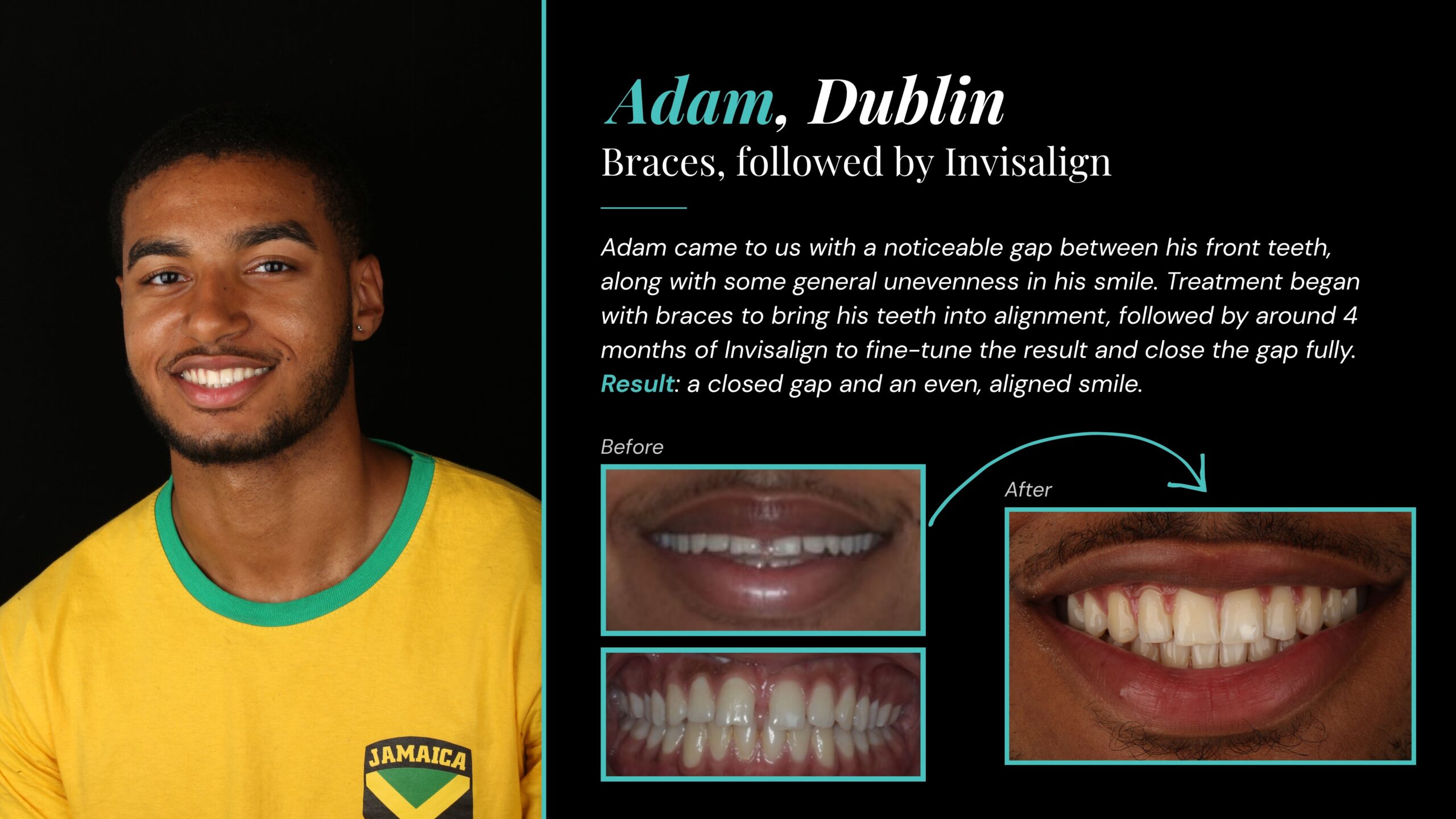
Braces — and sometimes Invisalign — can gently and gradually reposition teeth to close a gap. That said, this route isn’t always the right call: a gap is often the result of a mismatch between jaw size and tooth size, and in these cases, simply moving the teeth together may not give the cosmetic result you’re after. Where that’s the case, we’d usually recommend composite or porcelain to deliver the best outcome instead.
In some cases, a small piece of tissue between the front teeth (the frenum) has grown into the gap. If that’s what’s happening, it may need to be addressed to allow the teeth to close fully.
Dr Golara Farhoomand walks through how she decides between composite, veneers, and aligners for closing a gap.
Frequently Asked Questions
Do I need to close my gap?
Not necessarily. If your teeth are healthy and you’re happy with your smile, there’s no clinical need to change it. Closing a gap is a personal choice, not a requirement.
Which option is right for me?
It largely comes down to the size of the gap, your bite, and how permanent you’d like the result to be. This is best assessed in person, since every case is different.
Will closing the gap affect the rest of my smile?
It can — proportions matter. Widening just the front two teeth without considering the smile as a whole can leave things looking unbalanced, which is why we assess the full smile, not just the gap itself.
What if the tissue between my teeth (the frenum) is involved?
In some cases the frenum has grown into the gap, and addressing this may be part of the treatment plan. This will be assessed as part of your consultation.
Can I see what the result will look like first?
Yes — a Digital Smile Design session lets you preview and review the plan before any treatment begins.
Back to Blog
Talk to an Expert
Start Your Journey with Seapoint
We invite you to discover why thousands of patients choose Seapoint Clinic for their dental care. Whether you’re seeking routine care or a complete smile transformation, our team is here to provide you with the highest standard of dental excellence in Ireland.

