
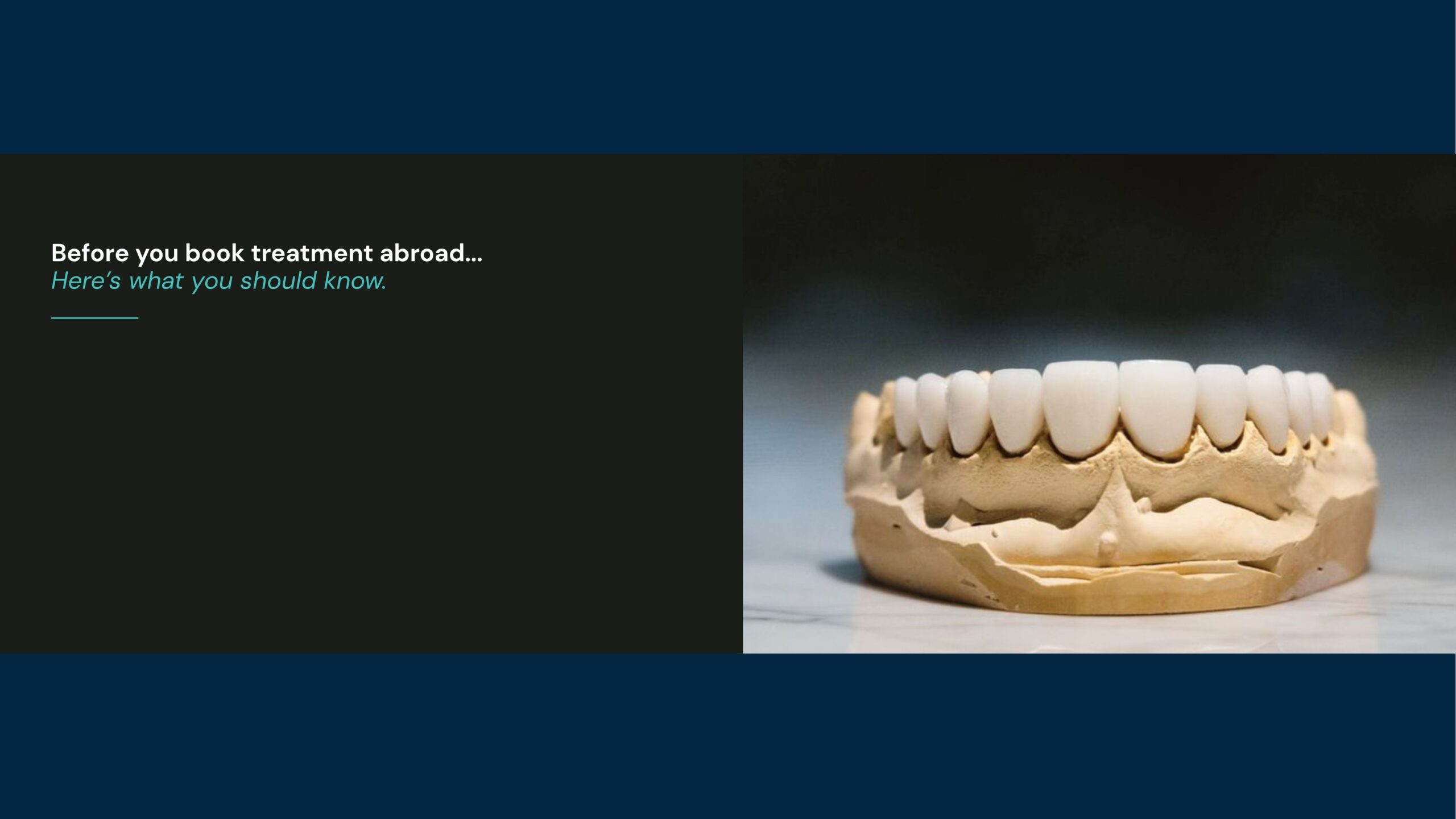

Turkey Teeth – what’s it all about?
Before You Book Treatment Abroad
If you have looked into cosmetic dentistry at all in the last few years, you have seen the ads. All-inclusive packages, a hotel, an airport transfer, a full set of teeth in four days, and a price that makes the Irish quote look absurd.
This article is not an argument that dentistry abroad is bad. It is an attempt to explain what is actually being sold, because most people comparing the two prices are not comparing the same treatment.
The short version: what is marketed as a “veneer” in most dental tourism packages is a full crown. Fitting one means grinding the tooth down on all sides, permanently. The comparison people think they are making — twenty veneers here versus twenty veneers there — is usually not the comparison in front of them.
Where This Comes From
Much of what follows is drawn from a conversation on our own Beyond The Smile podcast, where Ed O’Flaherty sits down with dentists and industry guests to talk honestly about modern dentistry — the good, the overhyped, and the genuinely risky. This episode features Dr Ambrish Roshan, a Dublin cosmetic dentist who trained at Trinity College and teaches minimally invasive technique to other dentists. You can watch the full conversation below.
First, the Fair Part
There are outstanding dentists in Turkey. One of the most respected cosmetic dentists in the world, Dr Galip Gürel, is Turkish, and clinicians across Europe have trained under him or built their technique on his work.
On the podcast, Dr Ambrish Roshan put it plainly:
“We have great dentists everywhere in the world. And unfortunately we have dentists who are more driven by what gets into their pocket everywhere in the world.”
This is not really about a country. It is about accountability. A dentist working in Ireland sees the same patient again in six months, and again in ten years, is registered with and answerable to the Irish Dental Council, and has a name to protect in the town they work in. A clinic whose entire patient list arrives by plane and leaves within the week never finds out how the work ages. Neither, often, does the patient, until it is far too late to do much about it.
The Word Doing the Selling
Here is the distinction that most treatment plans blur:
| What it is | What it costs the tooth | |
|---|---|---|
| Veneer | A thin facing bonded to the front surface of the tooth | Little or no enamel removed. Some cases need none at all. |
| Crown | A cap that covers the entire tooth, all the way around | The tooth is reduced on all sides, typically 360°. Often 60–70% of the tooth structure. |
Both get sold under the same word. Dr Ambrish messaged clinics anonymously through Instagram to test this:
“You message them on Instagram, and automatically a treatment coordinator comes back and says it’s twenty zirconia veneers. And it’s like, okay, but I just want my teeth to be whiter. Still twenty zirconia veneers.”
The plan does not change based on what you ask for, because the plan was never a response to your teeth.
What Came Back When We Asked
We ran the same exercise. We sent photographs of a healthy set of teeth to a clinic abroad and asked what could be done to improve the smile slightly.
This was a case where a hygiene visit, whitening, and a small amount of composite bonding on one minor chip would have covered it.
The plan that came back was twenty porcelain laminate veneers, at roughly €7,000, with a ten percent discount for cash. With flights and accommodation, closer to €8,000.
Now line that up against the conservative route for the same mouth. Straightening the teeth, whitening them, and adding a small amount of bonding only where it is genuinely needed will in many cases come to less than the package price — and in straightforward cases, considerably less. It removes no tooth structure at all. And it does not sign you up to a replacement cycle for the rest of your life, which is where the real long-term cost of twenty crowns sits.
So the money often runs the opposite way to how it is advertised. But the money is not the main point. One plan is reversible and the other is not.
What It Costs the Tooth
This is the part that does not show up in the before-and-after photos.
“Once we prep a tooth, we can’t unprep it. Once tooth structure is removed, we cannot replace that. No matter what we tell ourselves.”
Enamel does not regenerate. Once a healthy tooth has been reduced to a peg to carry a crown, that tooth is a crowned tooth for the rest of your life. Every future problem with it gets solved on top of a smaller starting point.
There is a second step that rarely gets mentioned in the sales conversation. When teeth are prepared aggressively, the nerve is often irritated or exposed, so root canal treatment gets done as part of the package. Sometimes it is done pre-emptively, on healthy nerves, because it is faster than managing the alternative.
“We’ve heard of patients going across to Turkey and coming back with essentially a full arch fully prepped, 360 degrees, every single tooth in the head, and also a root canal on every other tooth, where all they really may have needed, if anything, was a little bit of alignment and some whitening.”
A root canal treated tooth is more brittle and has a finite life. Doing twenty of them on healthy teeth to change their colour and alignment is a trade that is very hard to justify.
The principle worth carrying into any consultation, anywhere in the world:
“I’d rather the restoration fail than the tooth fail. Because I can replace a restoration.”
“Twenty to twenty-five years, and no, they don’t break”
That was the answer when a clinic was asked directly, on the podcast, how long the work would last.
The zirconia itself probably will not break. Zirconia is extremely strong. That is not the failure that matters.
What fails is the tooth underneath it, and the seal between the two. Decay gets in at the margin where crown meets gum, and because the tooth is covered you often do not see it or feel it until it is significant. Gums recede around poorly contoured crowns. Root canal treated teeth fracture. Bridges fail more often than single units.
And by then the clinic is in another country. Nobody flies back for one crown repair, which is precisely why the model works.
The Alternative: Alignment, Whitening, Bonding
Most people who go abroad for a smile makeover want three things: straighter teeth, whiter teeth, and better shape or symmetry at the edges.
There is a well established way to get all three without cutting a single healthy tooth. It is slower, and it does not photograph as dramatically on day one — which is exactly why it does not get advertised.
- Align first. Orthodontics does the heavy lifting. If the teeth are in the right position, you need far less restorative work to make them look right, and often none. Invisalign or fixed braces typically run six to eighteen months depending on the case. Nothing is removed from any tooth.
- Then whiten. Whitening changes shade without touching structure, and it is repeatable years later when it fades. Crucially it comes after alignment and before any bonding, because composite cannot be whitened once it is placed. Getting this order wrong is one of the more common mistakes.
- Then bond, only where it is needed. Composite bonding adds material to build up worn edges, close small gaps or reshape a tooth. It is additive rather than subtractive. It can be repaired, adjusted, added to, or removed entirely, and the tooth underneath is untouched.
The result is a conservative one. It looks like your teeth on a good day rather than a new set of teeth, and it leaves every option open for the rest of your life.
Being honest about the downsides: composite is not permanent and it is not right for everyone. It stains, and how badly depends a great deal on the person:
“I’ve seen some of my own work after two years looking a little bit shoddy, and others, exactly the same technique that I’ve used for the last five or six years, and they’re looking pristine as day one.”
Heavy coffee drinkers and smokers should expect more maintenance, and for some people porcelain genuinely is the better long-term answer. Bonding needs polishing and occasional repair, and it will need replacing eventually.
The point is not that bonding beats porcelain. It is that the sequence matters, and that irreversible work should be the last resort rather than the opening offer.
And When Porcelain Is the Right Answer
Sometimes it is. Teeth that are already heavily filled, badly worn, discoloured from the inside, or structurally compromised will not be fixed by alignment and whitening.
Even then, how much tooth gets removed varies enormously with the material and the skill of the technician. A feldspathic veneer made by a good ceramist can be fitted with minimal preparation. Other materials require significantly deeper reduction to meet the manufacturer’s specification. Same word on the treatment plan, very different amount of tooth in the suction.
The question to ask is not “veneers or not.” It is “how much of my tooth are you removing, and why is that amount necessary?”
If You Have Already Had It Done
Plenty of people reading this are past the decision, and are here because something has started to hurt or look wrong. A few things worth knowing:
- It is not automatically a disaster. Some of this work is perfectly acceptable and needs nothing more than good hygiene support and monitoring.
- Get an assessment, including radiographs, before anything else. What matters is the state of the teeth and roots under the crowns, and the health of the gums. You cannot judge either from the outside.
- The most common problems that turn up are sensitivity or pain from an irritated nerve, decay at the crown margins, gum inflammation and recession, and fractured units.
- Not everything has to be redone at once. Individual failing units can often be dealt with on their own.
- Ask whoever assesses you what the realistic options are, including doing nothing for now.
If you are in discomfort, a root canal assessment or a hygiene and periodontal review is usually the starting point rather than replacing the cosmetic work.
Questions Worth Asking Before You Book Anything
Anywhere in the world, including here:
- Is this a veneer or a crown? How much tooth structure is being removed, in millimetres?
- Why is this the recommendation rather than alignment and whitening?
- Are any of these teeth having root canal treatment, and if so, why?
- Who is doing the work, what are their qualifications, and where can I see cases they have done themselves at five and ten years?
- What happens if something fails in three years?
- Can I see a mockup of the result before anything irreversible happens?
That last one matters more than it sounds. A digital plan and a physical trial smile let you see the outcome in your own mouth before a drill is used. If a treatment plan cannot show you that, it is worth asking why.
Back to Blog“Before you get on that plane, before you book the flights, think about what it is that you actually want to change, and speak to someone who can guide you in the right direction.”

Talk to an Expert
Start Your Journey with Seapoint
We invite you to discover why thousands of patients choose Seapoint Clinic for their dental care. Whether you’re seeking routine care or a complete smile transformation, our team is here to provide you with the highest standard of dental excellence in Ireland.

